Hyperballads
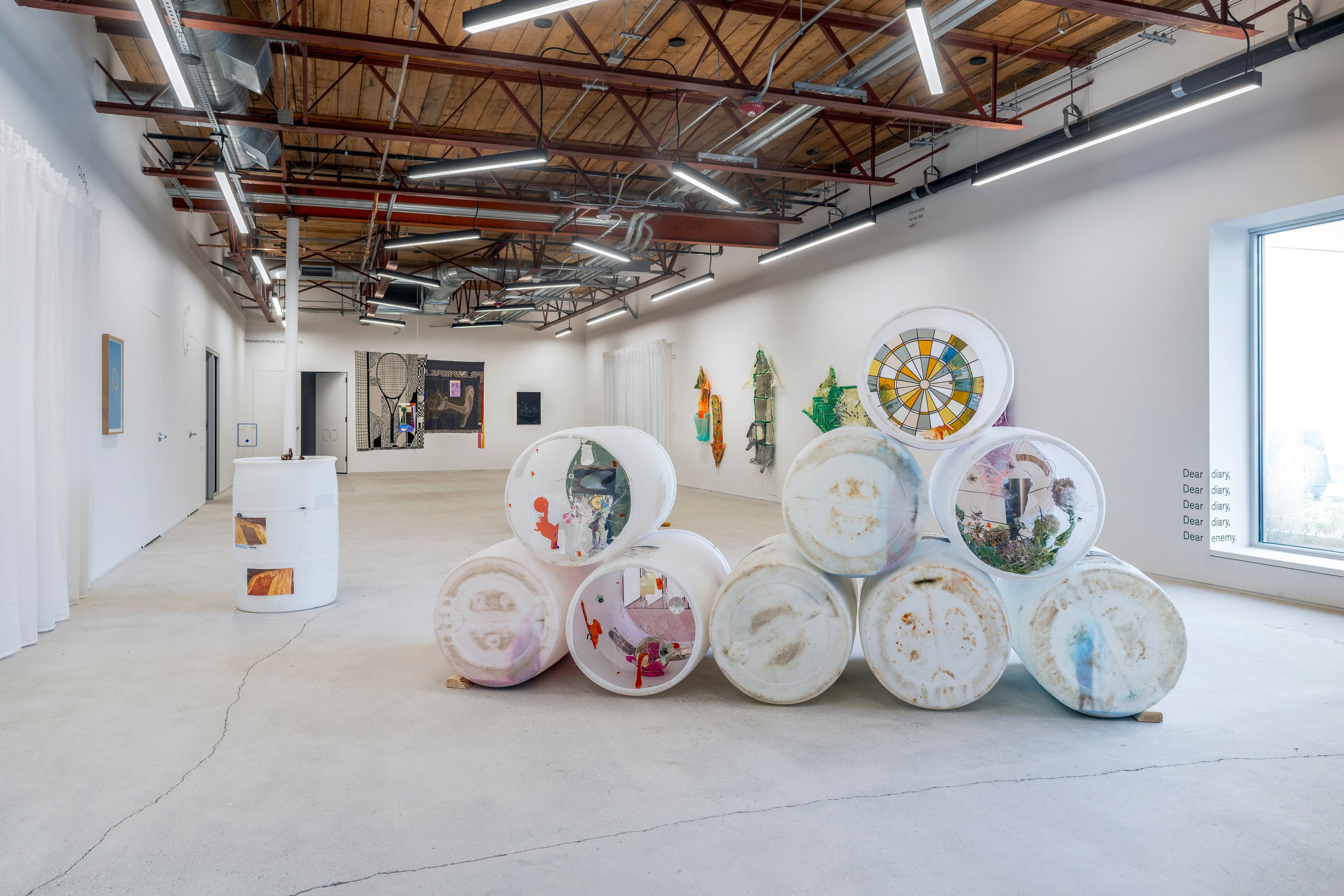
“Our bodies are moving, can you feel it?”¹
Some might say we live in a time of hyperness. As a term and concept, hyper can point us to worlds driven by speed and productivity, overexcited and overstimulated, confused, fanatical and polarized. It has been used in science and technology, culture and economics to translate the intensity of global flows of goods, information and organisms, as well as new forms of social organization in an increasingly hyperglobal and hypercapitalist world. But, at the same time, hyper can also translate what we might feel and can't see, what surpasses us and exists beyond. That is non-local and undulating through time. That transcends us somehow.
In that sense, hyper helps augment and fictionalize our realities, giving life and expression to impossibility. It mixes “histories with artifacts, it unfolds parallel dimensions and helps shape ontological eccentricities”². Wandering into these dilated temporal and spatial dimensions can show us the dangers and threats of the unseen (or of what we can't see entirely), making us vigilant and alert, as it can also help expand perceptions and boundaries and generate new associations or other understandings and strategies of conviviality and resistance. Faced with the social, economic and climate crisis, which threatens human and non-human well-being, social justice and the planet, various movements and manifestos emerge to seek alternatives while repurposing the rhizomatic qualities of the hyper(structure). This may allow for new alliances and symbiotic relationships and a need to experiment (and rediscover) other forms of knowledge (many times disregarded by scientific practice) that are built from intuition and humor, ancestrality, otherworldly, cosmic, and Dreamtime origins.
The exhibition gathers works that position us in constant movement. Like a hypertext, it exists non-linearly through different objects that are full of objects that are full of objects, revealing itself between the infinitely small and the infinitely large, from the body to the cosmos, from the visible to the unknown, from gesture to the apparently static. There are bodies that transcend their own physicality and hyperobjects that present us with affection and desire, digital and interconnectedness, the social and community, politics and resistance, consumption and subjugation. We experience confusion and the need to pull from (and to pull apart) systems of communication to explore unexpected links between experiential senses and the ways in which we interpret structures and information that we cannot see entirely. We speak of relations maintained and troubled by distance, memory, and forgetting, but also by love and empathy. We see Ideas, beliefs, and perspectives travel with the movement of people, animals, and microbial life. As we play and understand what it means to listen and participate in a dialogue, new balances are established. We deny paralysis, only to explore the force majeure³ of what is about to be set in motion.
Supposedly, Björk's song hyperballad⁴ inspired philosopher Timothy Morton's term Hyperobjects⁵, which he uses to refer to objects so massively distributed in time and space as to transcend location, enveloping us in them. Implicating us. Connecting us. Bjork sees her work as an essentially collaborative enterprise - implicated and connected, one that calls for an entire community of creative individuals. What drives this commonality of practices is a deep curiosity about the other and a real interest to play with, to listen to, and to announce (other) possibilities. The worlds they envision are ones of expanded form and existence, beyond conventional perceptions of time and space, bending them and flattening them.
We should attempt these collective ballads!
Artists: Allyson Vieira, Beatriz Brum, Eva Papamargariti, Gil Ferrão, Gonçalo Preto, Horácio Frutuoso, Nadia Belerique, Sónia Almeida, Yuli Yamagata.
1 Quote from Supernatural - Jorge Jácome & André e. Teodósio, 2022
2 Fiction Practice: Prototyping the Otherworldly, Mariana Pestana, 2020
3 Greater force
4 The title of the exhibition references Bjork' song Hyper-ballad, from her album Post, 1996
5 Hyperobjects - Philosophy and Ecology after the End of the World, Timothy Morton, 2013
Exhibition Text here (EN)
Curated by Jesse James.